
The History of Soap: From Ash, Fat and Water to a Living Craft
Explore the history of soap from early Mesopotamian records and Aleppo workshops to Ottoman bath culture, industrial chemistry and today’s handmade bars.
When we pick up a bar of soap, we rarely think about how much history it carries. Yet soap connects agriculture, trade, city life, chemistry and everyday labour. At the heart of the story are three simple elements: fat, alkali and water. Learning to combine them safely and consistently, however, took thousands of years of observation and accumulated skill.
Watch the history of soap
Start with this visual journey through soapmaking history, then read on for the historical context, distinctions and sources behind the story.
Soap was not invented in a single moment
There is no known individual inventor or exact birthday for soap. Different communities may have independently noticed that ash helped lift grease from fibres and surfaces. Alkaline compounds in plant or wood ash can react with fats to create soap-like cleaning substances.
Soap itself leaves little durable archaeological evidence, so historians rely mainly on clay tablets, medical texts, trade records and written formulas. An academic review published by the American Chemical Society places the earliest written evidence for soap production in third-millennium BCE Mesopotamia. These early mixtures were probably used chiefly in processing and washing textiles.
They should not be imagined as perfectly balanced modern bars. “Soap-like substance” or ancestor of soap is often the more accurate description.
Mesopotamia: cleaning as production technology
Textile manufacture was central to urban economies in Mesopotamia. Wool had to be cleaned of grease and dirt before spinning and dyeing. References to mixtures of fats and alkaline materials show that cleaning was not merely domestic hygiene; it was part of an organised technology of production.
Soap-like materials could serve textile work, surface cleaning and certain medical preparations. Their strong association with routine personal washing developed gradually rather than appearing at the very beginning.
Egypt, Greece and Rome
Ancient Egyptian sources describe preparations combining fats or oils with alkaline salts. Some relate to textile treatment, while others are associated with bodily care or medical use. Still, ancient bathing cannot be understood through soap alone. Oils, scented ointments, clays, abrasive materials and scraping tools also played important roles.
Greek and Roman bathing culture depended heavily on water, steam, oil and the strigil, a curved scraping tool. The Roman author Pliny mentioned a fat-and-ash substance called sapo, but its use did not simply mirror today’s hand soap; it was associated with hair and bodily care in several forms.
It is therefore too simple to say either that Romans did not know soap or that they bathed exactly as we do. Soap was known, but it was not the sole centre of cleaning culture.
The Islamic world and the maturation of soapmaking
During the medieval period, chemical knowledge, distillation, oil trading and urban crafts flourished across the Islamic world. In the olive-growing eastern Mediterranean, hard soap production became a more regular and specialised craft. Cities including Aleppo, Damascus and Nablus became associated with strong soapmaking traditions.
Soap was no longer merely a simple household mixture. Selecting raw materials, boiling, spreading the paste across a floor, cutting, stamping, stacking and curing required organised labour and trained judgement. Soap houses stood where agriculture, commerce and urban manufacture met.
Aleppo soap as living heritage
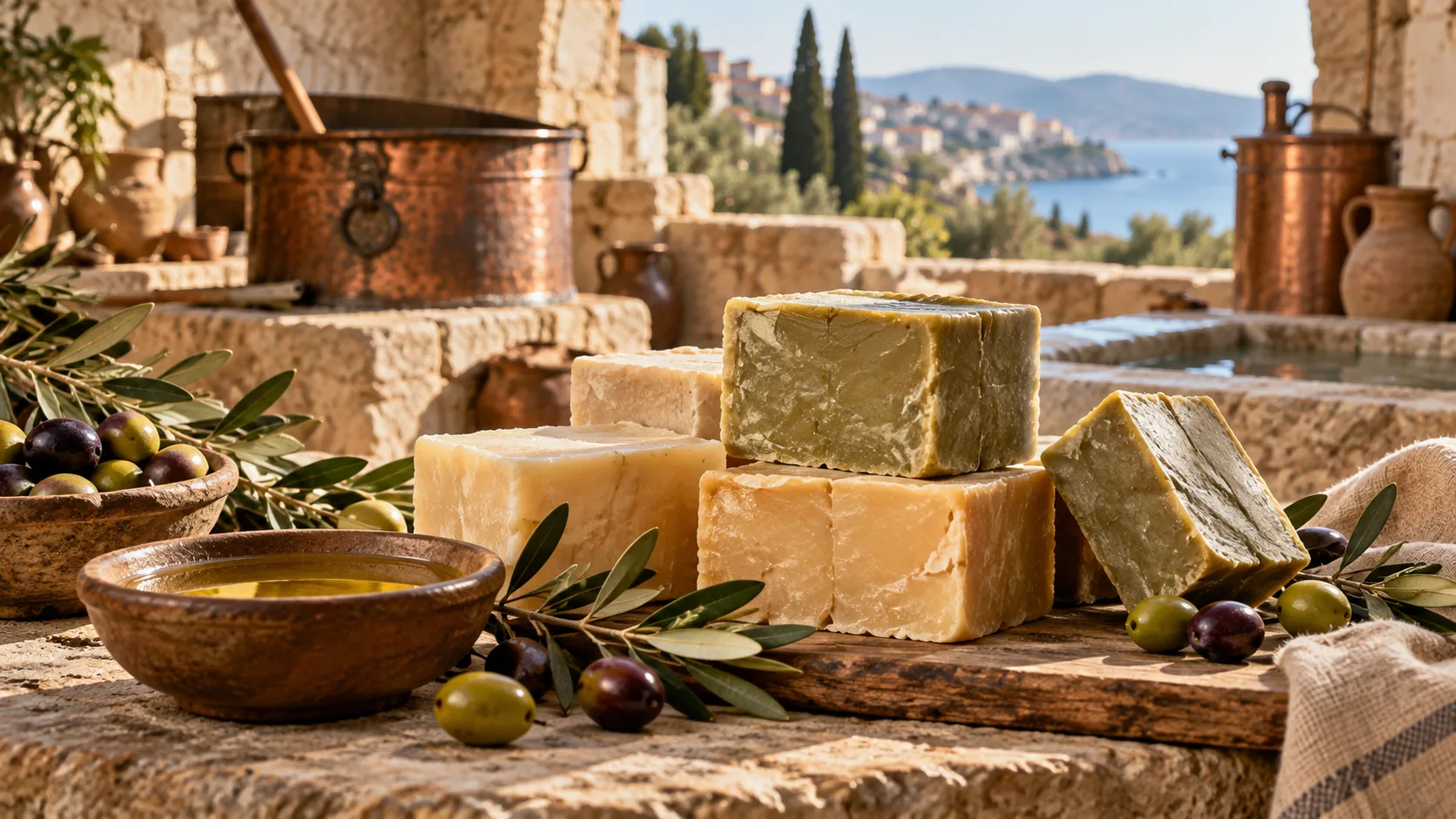
Traditional Aleppo ghar soap is made with olive oil, laurel berry oil, water and alkali. The cooked paste is spread across a large floor, left to set, cut into blocks, stamped with the maker’s mark and stacked in airy towers to mature.
As it ages, the outer surface may turn golden brown while the inside retains a greenish colour. Its significance lies not only in a formula, but also in seasonal knowledge, the ability to judge ingredients and consistency, and the inherited choreography of cutting and drying.
In 2024 UNESCO inscribed the craftsmanship of Aleppo ghar soap on the Representative List of the Intangible Cultural Heritage of Humanity. The recognition concerns a living tradition of families, apprenticeship, local knowledge and communal practices—not merely a commercial bar.
Soap cities of the Mediterranean
The olive-growing Mediterranean offered an ideal setting for soapmaking. From Aleppo and Nablus to Crete, Anatolia, Marseille and Castile, communities developed recognisable traditions shaped by local oils, alkaline sources, trade routes and production habits.
Castile soap became associated with olive-oil-rich hard bars. Marseille grew into a major European manufacturing centre with large soap works and regulated production practices. Each tradition demonstrates how the same basic chemical transformation can take on a distinct local identity.
Soap in the Ottoman world
Across Ottoman territories, soap was both an everyday necessity and a valuable commercial product. Soap houses developed in olive-producing areas of western Anatolia, the Aegean islands, Crete and the eastern Mediterranean. Aleppo, Damascus and Palestinian cities were also woven into the empire’s broad trade networks.
Production depended directly on the oil supply. Decisions about whether olive oil would be used for food, lighting or soap could affect prices and local economies. Quality, taxation, shipment and market control therefore appear in administrative as well as commercial records.
Ottoman bath culture gave soap a particularly visible social setting. The hammam was not simply a place to wash; it was a setting for social life, care practices and rites of passage. Soap, exfoliating mitts, towels, bowls and fragrance formed its material world.
Regional soaps associated today with olive, laurel, terebinth and other plant oils reflect both agricultural geography and local knowledge. Yet traditions also changed through migration, industrialisation, trade and regulation; they should not be presented as completely untouched survivals.
When chemistry caught up with craft
People made soap for millennia without a molecular explanation of saponification. Skilled makers read consistency with their eyes, judged heat through experience and followed inherited knowledge to balance fats and alkali.
From the late eighteenth century, industrial chemistry transformed production. Nicolas Leblanc’s 1791 process made large-scale manufacture of soda ash from salt possible. A more regular and abundant alkali supply supported the growth of glass, textiles, paper and soap, although the Leblanc process also produced severe pollution.
In the early nineteenth century Michel-Eugène Chevreul investigated fats and soap, identifying distinct fatty acids and clarifying the nature of the reaction. Soapmaking could now be explained more precisely as chemistry, not only practised as inherited craft.
In simple terms, saponification occurs when triglycerides in fats react with a strong alkali to form glycerol and fatty-acid salts—soap. Sodium hydroxide is commonly used for hard bars, while potassium hydroxide is commonly used for liquid or soft soaps. In a correct formula and completed reaction, the alkali does not remain in its starting form; it participates in making the soap. That does not make raw alkali harmless: during production it is highly corrosive and demands rigorous safety precautions.
Industrialisation and mass soap
During the nineteenth century, standardised raw materials, steam power, cutting and moulding equipment, packaging and advertising carried soap to much larger markets. The stamped bar from a local soap house increasingly shared the shelf with wrapped, branded consumer products.
Urbanisation, clean-water infrastructure, sewerage and the acceptance of germ theory changed washing habits. Soap became central to personal care and public-health practice. Access, however, did not expand equally everywhere, and reliable access to water and soap remains uneven today.
The twentieth century and synthetic detergents
The development of synthetic surfactants created a much wider world of cleaning products. Detergents that performed well in hard water largely displaced traditional soap in laundry and household cleaning. Shampoos, liquid cleansers and solid synthetic cleansing bars became distinct formulation categories.
Consequently, not every bar casually called “soap” is chemically traditional soap. True soap consists of sodium or potassium salts of fatty acids; syndet bars use other surfactants. Neither category is automatically good or bad in every situation. Purpose and the complete formula matter.
Why handmade soap has returned to view
Interest in handmade soap has many sources. Some people value shorter ingredient lists; others are drawn to local oils, traditional methods, plastic reduction, meaningful gifts or the story of a small maker. Many simply want to understand how an everyday object is made.
Yet “handmade,” “natural” and “traditional” are not guarantees of quality. Good soap requires a safe formula, careful production, sufficient curing where applicable, transparent ingredient information and responsible claims. The worth of the craft comes from informed labour, not rustic appearance alone.
What is held inside a bar of soap?
A bar may look like an ordinary object that disappears with use. Inside it, however, are the experience of Mesopotamian textile workers, Mediterranean olive groves, Aleppo’s soap towers, the social world of Ottoman hammams, the discoveries of nineteenth-century chemistry and the labour of today’s small workshops.
The history of soap reminds us that craft does not mean repeating the past unchanged. It means carrying knowledge forward while adding modern safety, science and responsibility. Every careful contemporary soapmaker writes another line in this thousands-year-old story.
Frequently Asked Questions
When was soap first made?
The earliest written evidence for soap-like production dates to third-millennium BCE Mesopotamia. Earlier accidental discovery is possible, but no firm written or physical evidence proves it.
Who invented soap?
There is no known single inventor. The cleaning effect of fats and alkaline materials was observed and developed by different communities over many centuries.
Was ancient soap the same as modern soap?
No. Early mixtures varied greatly and were often linked to textiles, surfaces or medical preparations. A standardised hard bar reflects much later production knowledge.
Can soap be made without lye?
True soap is created when fats react with an alkali. Today this is usually sodium or potassium hydroxide. A maker using melt-and-pour base does not handle raw lye, but alkali was used earlier to manufacture the base. Ash water is also alkaline.
What makes Aleppo soap culturally important?
Its value includes its olive-and-laurel formula, seasonal production, boiling, floor spreading, cutting, stamping and long curing tradition. UNESCO inscribed its craftsmanship as intangible cultural heritage in 2024.
Where was soap produced in the Ottoman Empire?
Important production developed in olive-growing western Anatolia, the Aegean islands, Crete and the eastern Mediterranean. Major centres in Aleppo, Damascus and Palestinian cities also formed part of Ottoman commercial life.
Is natural soap the same as a syndet bar?
No. Traditional soap is made of fatty-acid salts, while a syndet bar uses other synthetic surfactants. The suitability of either depends on its purpose and overall formulation.
Is handmade soap always better?
No. Handmade production alone does not prove quality or safety. Sound formulation, hygienic practice, curing, transparent labelling and regulatory compliance all matter.
Sources
- American Chemical Society — An Ancient Cleanser: Soap Production and Use in Antiquity
- UNESCO — Craftsmanship of Aleppo Ghar Soap
- Science History Institute — Making the Process
- AOCS — Michel Eugène Chevreul (1786–1889)
- International Journal of Multidisciplinary Hygiene Research — Sabunun Tarihi Üzerine Bir İnceleme