How to Choose Fabric Thread and Needles for Embroidery
Good embroidery depends on a compatible system: fabric structure, thread weight, needle point and hoop tension must support the technique and intended use.
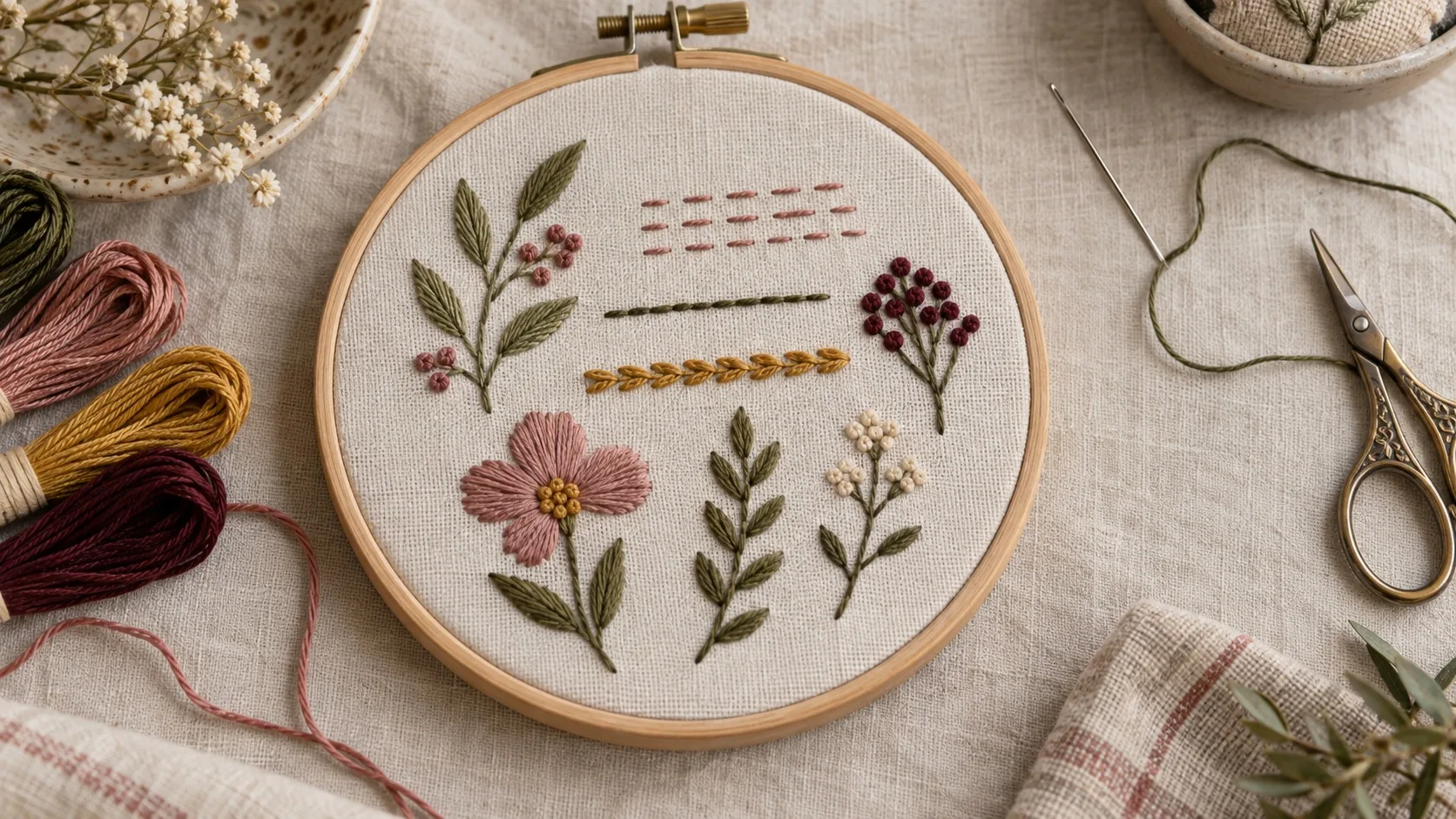
Start with technique and use
Material choice is not about finding one universally superior product. A wall piece, washable towel, garment and bag require different strength, drape and care.
Surface embroidery can follow a transferred drawing without counting the weave. Cross-stitch and other counted methods depend on evenly spaced holes. Tel kırma uses a special needle and flat metal wire, so ordinary thread advice does not automatically apply.
Choosing fabric
A stable medium-weight cotton or linen blend that accepts a needle comfortably is useful for beginners. DMC recommends flat cotton such as percale, evenweave or linen for general hand embroidery and notes that stretchy fabrics may need stabiliser to prevent distortion.
Heavy thread and dense filling can pull delicate cloth, while fine thread may disappear on a coarse ground. Test penetration and puckering on a scrap. Prewashing washable fabric can reduce later shrinkage.
Choosing thread
Six-strand cotton floss allows strand count to change line weight. Pearl cotton has a rounder sheen and is normally used without separating it. Wool, silk, metallic and synthetic threads create different surfaces and require different care.
Consider fibre, weight, abrasion, washing and compatibility with the fabric, not colour alone. Long dark floats may show through pale fabric, so plan the back of the work as well as the front.
Choosing needles
A sharp embroidery or crewel needle pierces fabric for free surface work. A blunt tapestry needle passes through holes in counted fabric without splitting its threads. Thick decorative thread may require a chenille needle with a larger eye.
In many sizing systems, higher numbers indicate finer needles, but labels vary by type and maker. The practical test is simple: thread should pass through the eye without damage, and the needle should not leave an unnecessarily large hole.
Hoops, transfer and sampling
A hoop supports even tension. Too little tension creates uneven stitches; too much can mark or distort fabric. Small sharp scissors give a clean cut. Test removable pens, transfer paper or water-soluble stabiliser on scrap because some marks can become permanent with heat.
Make a sample using the chosen combination and wash it as the final object will be washed. Tospika allows visitors to ask makers directly about fabric, thread and care; it does not handle sales or payments and charges no commission.
Frequently asked questions
- What fabric is best for a beginner?
- A stable medium-weight cotton or linen blend that is easy to pierce and does not stretch is a practical starting point.
- Which needle is used for cross-stitch?
- A blunt tapestry needle helps pass through the holes of Aida or evenweave without splitting the fabric threads.
- How many strands of floss should I use?
- It depends on fabric, motif scale and desired coverage. Compare one, two and three strands on a sample.
- Can stretchy fabric be embroidered?
- Yes, but suitable stabiliser and controlled hoop tension help prevent stretching and puckering.
- Should fabric be washed before embroidery?
- For washable projects, prewashing can reduce later shrinkage. Check the care requirements of both fabric and thread.
Sources
- Embroidery Essential Toolkit — DMC dmc.com · Accessed: 2026-09-15
- How to Prepare Fabric for Embroidery — DMC dmc.com · Accessed: 2026-09-15
- Basic Stitches — Royal School of Needlework StitchBank rsnstitchbank.org · Accessed: 2026-09-15
Related content
The History of Embroidery and Anatolian Traditions
Embroidery has no single documented birthplace. In Anatolia, needlework developed into a layered field connecting court and household, ceremony and daily life, memory and skilled labour.
Read more
Basic Embroidery Stitches for Beginners
Learning embroidery begins with a small group of stitches that create lines, fills, leaves and texture, rather than memorising a long list of names.
Read more