Crochet: A 200-Year Tradition Reimagined by Today’s Makers
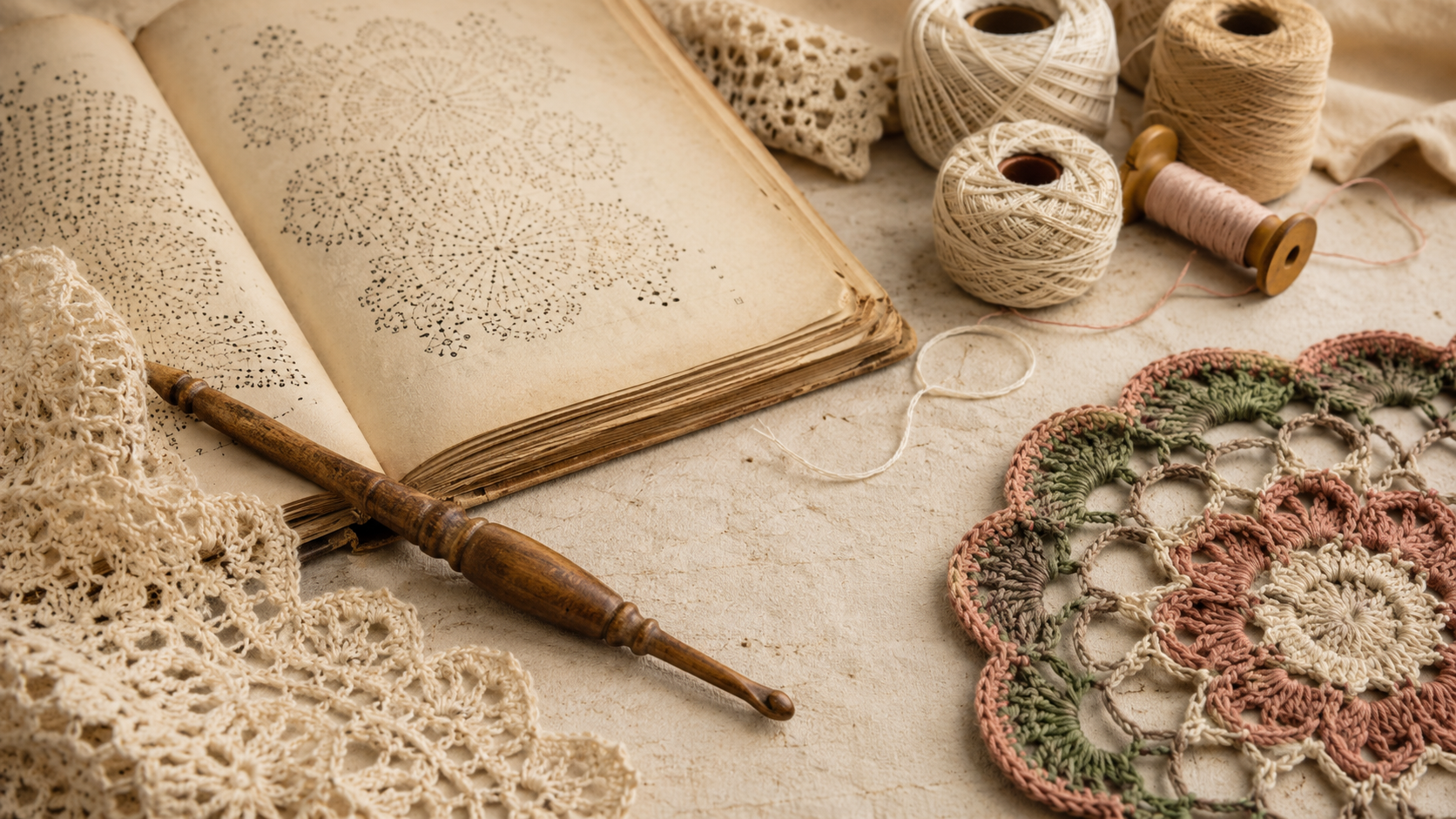
One hook, one strand of yarn and a sequence of loops: crochet can produce everything from amigurumi figures and bags to garments and home accessories. Its history, however, is less straightforward than popular accounts often suggest. Crochet is sometimes described as an ancient technique, but the strongest evidence for the craft in its recognisably modern form appears in the early 19th century.
Earlier cultures practised many forms of looping, knotting, netting and needlework. Those traditions helped create the wider textile world in which crochet developed, but they should not automatically be classified as crochet.
Does crochet have a known place of origin?
There is no conclusive evidence that crochet was invented by one person, in one country, on a particular date. Theories have linked its origins to Arabia, China and South America, yet none has been supported by a continuous and securely identified body of early crochet objects.
Part of the confusion comes from the similarity between finished textiles. Nålebinding, knitting, netting and tambour embroidery can create looped surfaces, but they use different tools and structures. Some early pieces once described as crochet were later recognised as examples of other techniques.
The most accurate summary is therefore that crochet grew from a much older world of looped textile practices, while its well-documented modern history spans roughly 200 years.
The first printed crochet instructions
One of the earliest known printed instructions to describe crochet in its modern sense appeared in the Dutch magazine Penélopé in 1823. During the 1840s, crochet became increasingly fashionable in Britain and continental Europe. Printed patterns allowed techniques to be repeated, taught and circulated far beyond a single household.
The French-Irish designer Eléonore Riego de la Branchardière played an important role in that expansion. Her publications translated the appearance of elaborate lace into patterns that could be worked with a crochet hook. The Metropolitan Museum of Art holds her The Crochet Book series, dated 1847–1851.
Where does the word “crochet” come from?
The English term “crochet” comes from French and is associated with a small hook. The name refers directly to the hooked tool used to draw yarn through loops.
In standard crochet, only one working loop usually remains active at the end of a stitch. This is one of the clearest structural differences between crochet and knitting, which normally keeps many live stitches on two needles.
Irish crochet and women’s work
Crochet was not only a fashionable pastime. During the Great Irish Famine of 1845–1849, crochet lace was taught as a form of income-generating work for impoverished families. Women, men and children took part in production, and finished lace was sold to buyers in Britain, Europe and North America.
Irish crochet interpreted the visual richness of needle and bobbin lace through a hook-based method. Raised flowers and leaves were often made separately and joined with a mesh-like ground. The technique became both a recognised decorative style and a way for people to earn money from home.
Crochet in Ottoman and Turkish textile culture
Anatolia has long traditions of needle lace, shuttle lace, embroidery and other forms of looped textile work. These should not all be grouped under the term crochet, because they are made with different tools and structures.
Clearly identified examples of crochet from the Ottoman world appear in 19th-century museum collections. The Metropolitan Museum of Art holds a piece catalogued as 19th-century Turkish crochet from Constantinople, providing material evidence that the technique had become part of the region’s textile culture by that period.
Crochet later found a place in headscarf edgings, dowry textiles, baby garments, household linens and decorative accessories. As in many regions, the craft carried both practical value and knowledge passed between generations.
From the 20th century to contemporary crochet
Crochet continued to respond to changing fashion. Fine lace, collars and household textiles were prominent in the early 20th century. Bright garments, bags and motif-based blankets became especially visible during the 1960s and 1970s.
The growth of industrial clothing did not eliminate the handmade practice. Today, renewed interest in slow production, personalisation and independent makers has brought crochet into contemporary wardrobes and interiors. Amigurumi, jewellery, phone straps, bags, baby items and sculptural objects demonstrate how adaptable the technique remains.
Why does handmade crochet still matter?
A crocheted object records many decisions: fibre, hook size, stitch tension, density, shape, colour and finishing. Even when two makers follow the same pattern, their hand tension and material choices may produce subtle differences.
That individuality is central to the value of handmade crochet. The object carries not only a design but also the maker’s time, judgement and skill.
To see contemporary work by women makers, explore handmade crochet products on Tospika.
Frequently Asked Questions
How old is crochet?
The well-documented history of modern crochet extends back roughly 200 years to the early 19th century. Older looped textile methods exist, but they are not necessarily crochet.
Where was crochet invented?
No single country has been conclusively identified as the birthplace of crochet. The earliest clear written evidence for the modern craft appears in 19th-century Europe.
Are crochet and knitting the same?
No. Crochet uses a hook and usually one active working loop. Knitting generally uses two needles and keeps multiple stitches active at the same time.
Is all Turkish oya crochet?
No. Needle lace, shuttle lace and crochet edging use different tools and constructions. Each should be identified according to how it was made.
Related reading: What Is Hand Crochet? Techniques, Stitches and Uses