What Is Tel Kırma? The History, Technique and Motifs of Bartın Wire Embroidery
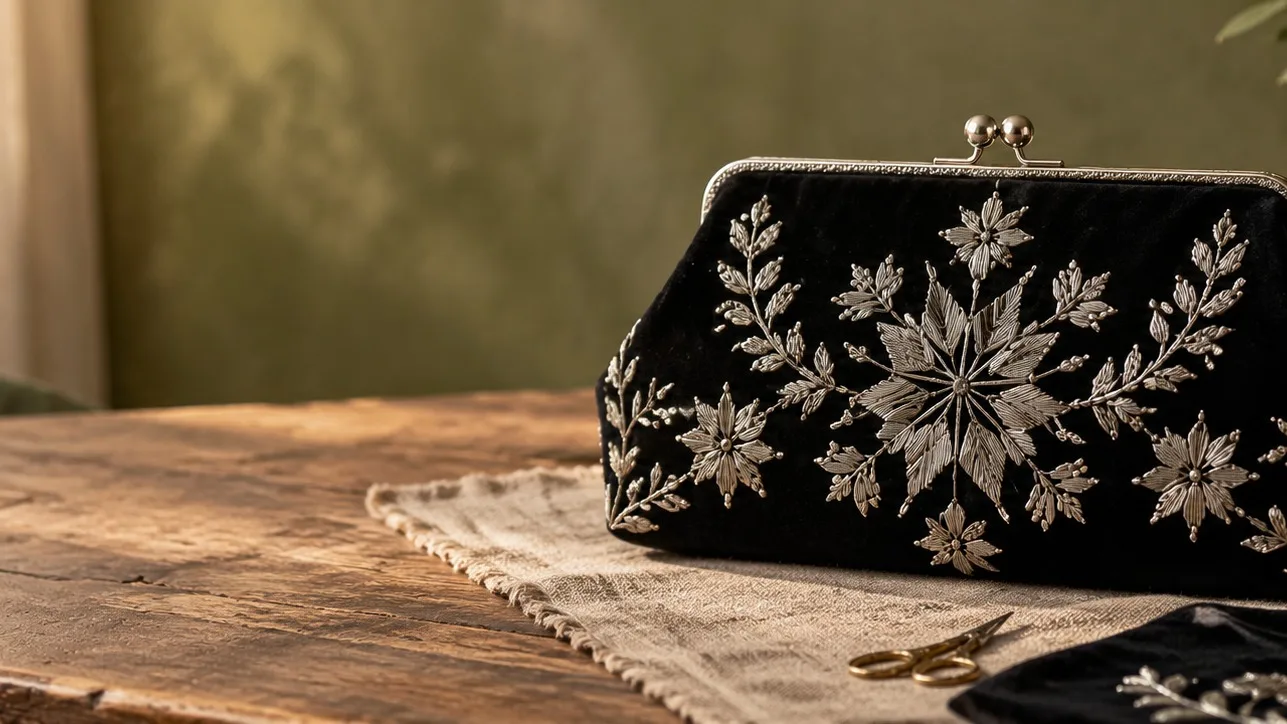
Small metallic marks catch the light and form a rhythmic pattern across fabric. From a distance tel kırma may resemble embroidery, but a closer look reveals that its surface is built with short pieces of flat metal wire rather than ordinary thread. Closely associated with Bartın in northern Türkiye, the craft is distinguished by its material, its special needle and the action that gives it its name: the wire is bent and broken by hand instead of being cut with scissors.
Tel kırma is no longer confined to heirloom covers and ceremonial textiles. Contemporary makers use it on bags, accessories, garments and decorative panels. These new forms can keep the craft visible when they respect the technique, acknowledge its cultural origin and describe materials honestly.
What does tel kırma mean
The Turkish words may be translated literally as “wire breaking”. A flat metal wire is guided through an open or countable weave with a special broad needle. After a small unit is positioned, the wire is bent and snapped by hand. Repeating this movement builds a motif from separate reflective marks.
Unlike conventional embroidery, traditional tel kırma does not rely on thread as its main decorative material. Each wire unit reflects light at a slightly different angle, giving the finished surface a lively appearance that changes as the object moves.
The names “tel kırma”, “Bartın work” and “Bartın tel kırma” are often used loosely in conversation. However, Bartın İşi Telkırma is also a registered Turkish geographical indication. The application was filed on 8 November 2004 and the product was registered on 19 January 2010 as geographical indication number 125. The protected name therefore refers to more than a visual resemblance; its use is connected with the production characteristics recorded in the registration.
History and the connection with Bartın
There is no single surviving document that identifies an exact inventor or starting year. Official sources from the Bartın Governor’s Office and Türkiye’s Culture Portal describe tel kırma as a craft reaching back to the seventeenth century. Some local and academic accounts place its recognisable development in the eighteenth century or later. Such differences are common in living crafts transmitted through households, dowries and master-apprentice relationships rather than through formal written records.
The central point is the craft’s strong development and cultural identity in Bartın. Bed covers, pillow covers, bundles and textiles for special occasions carried both decorative value and the technical knowledge of generations of women. Research on examples held by Amasra Museum also records the richness of their materials, patterns and compositions.
The technique acquired local uses outside Bartın as well. A study from Beypazarı documents white cotton headscarves known as “hamam beyazı”, decorated with flat silver-coloured wire and worn in bridal bath traditions. This shows how tel kırma could become part of different regional dowry and ceremonial cultures.
How tel kırma is made
The basic sequence is simple to describe but demanding to control:
- The motif is planned according to the weave and the object’s shape.
- Flat wire is placed in a special tel kırma needle.
- The needle passes through the gaps of the fabric without unnecessarily splitting its threads.
- The wire is laid in the intended direction and bent with the fingers.
- At the end of each unit the wire is broken by hand.
- Repetition joins many small metallic marks into a complete motif.
Wire direction, bending angle, spacing and fabric tension must work together. Loose work can leave raised wire ends; excessive tension can pull or distort the fabric. This is why clean and durable work depends on experience rather than on the pattern alone.
Materials and motifs
Traditional descriptions frequently mention black or white tulle and silver wire. Modern makers may use other stable woven fabrics and flat wires in silver, gold or copper tones. A colour description does not necessarily mean that a contemporary wire is made from pure precious metal, so responsible product information should identify alloys or coatings where known.
Stars, flowers, leaves, branches, geometric arrangements and symmetrical central motifs are common. Their meanings should not be reduced to a single universal dictionary. A form may be inherited from an older family piece, inspired by nature or selected primarily for its visual rhythm.
The short straight wire units give tel kırma a distinctive geometry. A round bag may use a design radiating from the centre, while a long textile may have a border. The balance between empty fabric and metallic light is as important as the motif itself.
From household textiles to contemporary bags
Türkiye’s Culture Portal lists sheets, bed and pillow covers, cushions, bed valances, bundles and covers among historical uses. Head coverings and ceremonial textiles also played an important role. Today tel kırma can appear on evening bags, belts, brooches, pendants, hair accessories, shawls, collars, cuffs, runners, wall pieces and bridal accessories.
A tel kırma bag brings the craft’s changing relationship with light into everyday use. When assessing a handmade bag, look beyond the front motif. The lining, closure, chain attachments, secure wire ends and reduced risk of snagging are all part of the workmanship. Slight variations in direction or spacing can be natural traces of hand production.
Care guidance
Metal-decorated surfaces may be affected by friction, moisture and chemicals. The maker’s instructions should always come first.
- Do not scrub or machine-wash the decorated surface.
- Keep it away from perfume, hairspray, cleaning products and persistent moisture.
- Store it separately in a soft fabric bag to prevent snagging.
- Do not place heavy objects on bags or panels.
- Preserve the object’s natural shape rather than keeping it tightly folded.
- Do not pull a lifted or broken wire; ask the maker or a skilled practitioner about repair.
Avoid using household metal polish on historical or heirloom pieces. Professional conservation advice is safer when an object has cultural or family value.
A living heritage supported by makers
The future of tel kırma depends not only on preserving museum pieces but also on making the labour of today’s practitioners visible. Information about the hours of work, wire and fabric, motif selection and intended use helps the viewer understand the object as a process, not merely as an accessory.
On Tospika you can discover tel kırma products and women makers working with the technique, then ask them directly about materials, care and custom work. Tospika is a showcase platform; it does not process sales or payments and does not charge commission.
Frequently asked questions
Is tel kırma the same as embroidery
It belongs to the wider world of textile decoration, but its main decorative material is flat metal wire rather than ordinary embroidery thread. The wire is bent and broken by hand after each small unit.
Why is it called Bartın work
The technique developed a strong identity in Bartın and spread from the region. Bartın İşi Telkırma is also registered in Türkiye as geographical indication number 125.
Is only silver wire used
Silver wire is prominent in traditional descriptions, while contemporary work may use silver, gold or copper-coloured wire. The colour alone does not prove the metal content.
Can a tel kırma bag be used every day
It can be used when the body, lining, closure and wirework have been designed for that purpose. The decorated surface still needs protection from friction, snagging and moisture.
Can tel kırma be washed
Routine machine washing is generally unsuitable. Care depends on both fabric and wire, so follow the individual maker’s instructions.
Discover tel kırma and handmade bags on Tospika, browse the maker profiles or send a custom production request.
Sources
- Türk Patent ve Marka Kurumu — Bartın İşi Telkırma, tescil no 125 (19.01.2010)
- T.C. Bartın Valiliği — Tel Kırma
- Kültür Portalı — Bartın İşi Tel Kırma
- Gören, S. — Gelenekten Geleceğe Bartın İşi Tel Kırma, Türük Dergisi 8(21), 2020
- Yetim, F. — Beypazarı İlçesinde Tel Kırma İşlemeli Hamam Beyazı Tülbentler, Akademik Bakış 42, 2014
- Amasra Müzesinde Bulunan Tel Kırma, Bartın İşi ve Hesap İşi İşlemeler Üzerine Bir Araştırma
Note: official sources trace the craft to the seventeenth century while some publications emphasise the eighteenth, so no exact year of invention or first practitioner is claimed here. General care advice does not replace the individual maker's instructions.