

The Origins of the Dowry Tradition in Türkiye: From Setting Up a Home to Cultural Memory
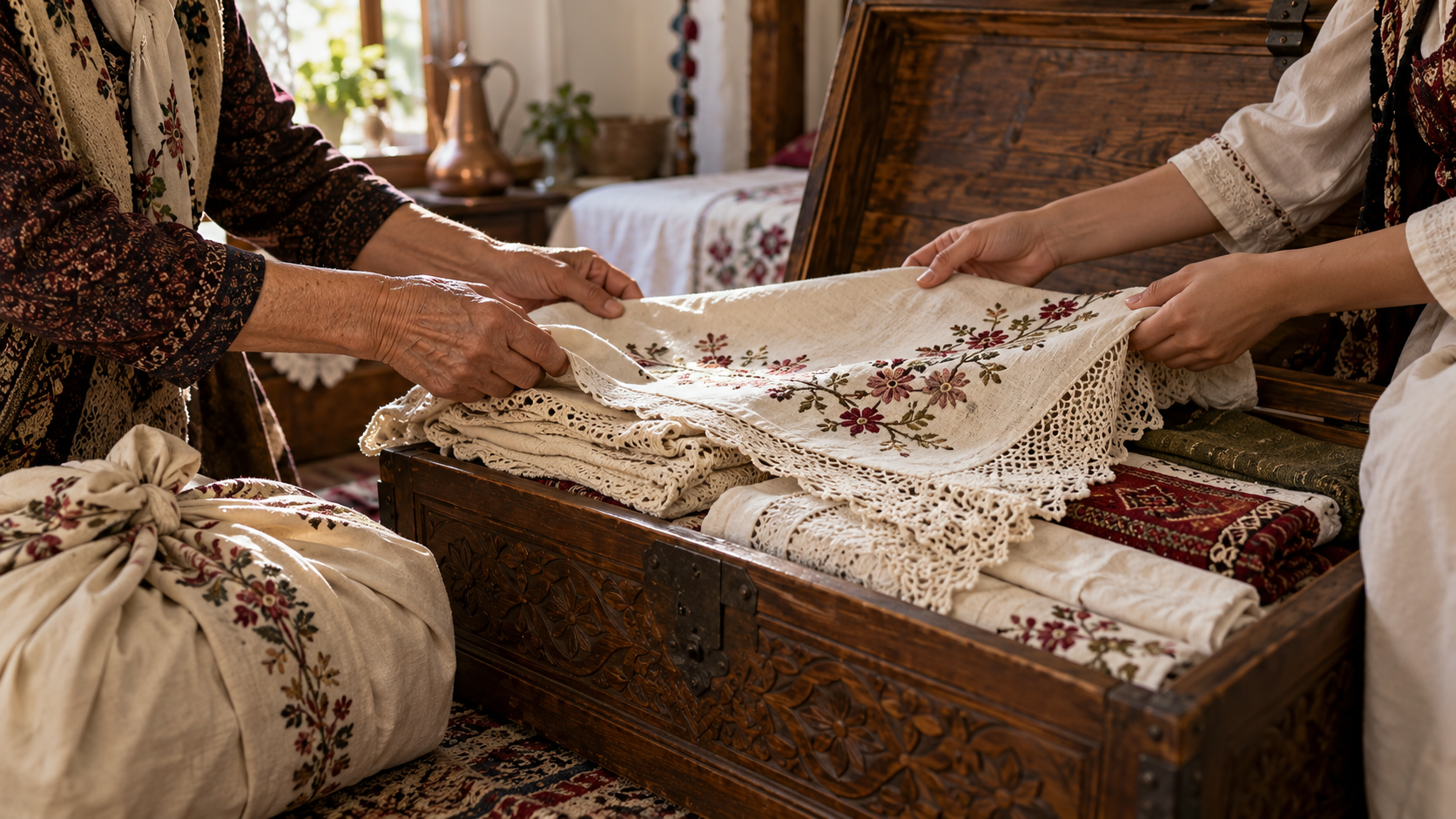
When setting up a home, deciding who will bring which items is not merely a practical matter. A family’s means, where they live, social expectations, and craft skills all play a part. In Türkiye, the preparations we call çeyiz—a bridal dowry or trousseau—have been shaped by these layers accumulating over time. In one home, a quilt and a few towels may count as çeyiz; in another, textiles prepared over many years; and in another, everyday items chosen together for a new life.
It would be inaccurate to say that çeyiz was “invented” on a single day or by one community alone. A better question is this: What historical and social forms did the need to bring household goods into a new home take in Anatolia?
Where does the word çeyiz come from?
According to the TDV Encyclopedia of Islam, the Arabic cehâz/cihâz refers to the equipment and necessities required by someone setting out on a journey or by a bride. In Turkish, it took the forms cihaz, çehiz, and çeyiz; çeyiz came to refer especially to the belongings a bride brought from her family home. The word’s origin reveals the central idea: preparing what is needed when beginning a new life. Source: TDV Encyclopedia of Islam.
Yet the origin of the word alone does not mean the practice arose from a single culture. Customs of preparing goods for marriage appear across a wide geography and in different periods. The understanding of çeyiz in Türkiye has likewise gained its present diversity as various local practices were layered together throughout history.
What need lay at its origin?
The most visible purpose of çeyiz is to prepare practical items for a new home. Bedding, covers, kitchenware, clothing, and personal belongings are gathered together. In earlier times, many household textiles were made at home or sourced from local artisans. Preparing to establish a household could therefore take a long time.
Folklorist Büşra Baysal’s study of the çeyiz tradition considers this preparation both a material need and a form of relationship-building and cultural transmission. The quantity and quality of çeyiz vary according to a family’s income; during the process, skills are learned and relatives may help one another. This shows that the tradition cannot be reduced to a single purpose. Source: Baysal, 2025.
The saying “The girl is in the cradle, her dowry in the chest” suggests that, in some circles, preparations were thought to begin as early as childhood. Yet this saying reflects a historical outlook; it is neither a practice followed by every family nor a rule to be observed today.
What do we know from the Seljuk and Ottoman periods?
The section on Ottoman çeyiz customs in the TDV Encyclopedia of Islam notes that embroidered pieces, woven textiles, and kitchenware were among çeyiz items during the Seljuk and Ottoman periods. Ottoman examples include both everyday and embellished objects such as towels, headscarves, bed linens, and copper vessels. However, this extensive list should not be read as a fixed “Ottoman dowry” owned by every family: the source also stresses that the items varied by region and economic circumstances. Source: TDV Encyclopedia of Islam, “Dowry Customs among the Ottomans”.
The same source also describes lavish dowry processions at palace weddings. Although palace customs were highly visible, they did not directly represent everyday life. The scale and contents of çeyiz prepared in a village, town, or urban household depended on different circumstances. When looking at history, it is important to distinguish spectacular examples from the preparations of ordinary homes.
Did the chest always have the same form?
Today, the dowry chest is a powerful symbol of the tradition. Yet historically, tracing çeyiz solely to the wooden chest leaves the picture incomplete. Keeping belongings in portable forms such as bohça bundles and hurç storage bags was also an established custom. The use and form of chests varied according to period, place, and economic means.
A furniture history study on dowry chests discusses portable storage forms and built-in cupboards in homes, linking the chest’s widespread use particularly to changes in ways of life during the 19th century. This interpretation does not mean that “chests were never used before then.” The tradition of storing belongings and the spread of a particular type of furniture are distinct historical questions. Source: Yalçın Usal, 2010.
When the maker of an embroidered piece kept inside a chest is known, the piece also becomes a personal record. A daughter completing a cover begun by her mother, or an heirloom moving into a new home, gives an object sentimental value alongside its practical use.
Why was çeyiz displayed?
In some regions, çeyiz was displayed in the home before the wedding; elsewhere, it was viewed after being moved into the new home. Practices of arranging, hanging, and exhibiting the pieces may be called çeyiz serme, or known by local names. A Ministry of Culture and Tourism compilation on marriage traditions records an example in which the prepared handiwork was shown to guests. Such compilations describe particular practices; they do not indicate that the exact same ceremony took place throughout Türkiye. Source: Ministry of Culture and Tourism.
One aspect of the display was visibility: it made clear who had created embroidery, woven textiles, or needle lace over months, sometimes years. The other was comparison. Judging a bride-to-be and her family by the number, display, or cost of the items could become a source of pressure. Any account of çeyiz culture must acknowledge both the value of handcraft and these social expectations.
Was çeyiz provided only by the bride’s family?
In everyday language, çeyiz is most often associated with the bride’s family. Historically, however, who provided what for the new home varied from region to region. The Ottoman examples in the TDV Encyclopedia explain that in some places kitchenware was supplied by the groom, while elsewhere other forms of sharing were found. Presenting çeyiz as an unchanging shopping list across every region erases this diversity. Source: TDV Encyclopedia of Islam.
These terms should not be confused: çeyiz refers to the belongings and preparations taken into a marriage, while bride price describes a different marital practice. In some local examples, the two may be related, but they are not synonymous. Religious law also includes discussions about furnishing the home; these should not be read as a single rule for çeyiz that every family today must follow. Source: TDV Encyclopedia of Islam.
Women’s labour: skill, solidarity, and invisible burden
A piece woven or embroidered for çeyiz often carries the knowledge of more than one person. A grandmother may have taught the motif, a mother chosen the fabric, and the bride-to-be completed the embroidery. Preparing çeyiz thus became a space where technical and aesthetic knowledge could be passed on without a formal school. One study of dowry chests interprets the chest as a bearer of solidarity and cultural transmission among women. Source: Gümüşhane University Journal of Social Sciences.
Yet celebrating “handmade work” should not render invisible the unpaid time expected from the woman who creates it. For some, preparing çeyiz may be joyful and an opportunity to make things and spend time together; for others, it may be a demanding duty that must be completed. An art study published in 2026 examines this tension by considering çeyiz through women’s labour and gender roles. A balanced discussion of the tradition values the work while refusing to turn anyone’s labour into a test of suitability for marriage. Source: Demir, 2026.
Why is there no single çeyiz list in Anatolia?
As climate, available materials, family incomes, local crafts, and domestic arrangements varied, so did the objects prepared. In one place, woven textiles or quilts might take centre stage; elsewhere, needle lace, embroidery, or kitchen textiles might be more prominent. A field study of Erzurum examined differences between past and present çeyiz items, further illustrating the tradition’s local and evolving nature. Source: Karakelle and Özbağı, 2019.
This diversity is key to understanding the tradition. When learning the name, motif, or use of an old piece, asking about the maker’s region and family story is more valuable than relying on a ready-made explanation for “all of Anatolia.”
What changed as ready-made goods became widespread?
Industrially produced home textiles, urban life, and changing housing arrangements transformed both the duration and contents of çeyiz preparation. Some objects once made at home can now be purchased ready-made. Rather than filling a chest over many years, it is also possible to choose pieces according to the dimensions of the new home and what will genuinely be used.
Handcraft, however, has not disappeared. A family may preserve an old cover; a maker may interpret a traditional technique in contemporary colours; or only a few personal pieces may be prepared for a new home. This is not the continuation of historical çeyiz in precisely the same form, but its re-creation according to need and preference.
One way to approach çeyiz today is to ask, before “What should be in it?”: “What will be used in this home, who wants this piece, and how will the maker’s labour be compensated?” In this way, sentimental value and practical need can support one another.
Frequently asked questions
When did the çeyiz tradition first begin?
It is not possible to give a single, definitive starting date. Preparing goods for marriage is a practice found in different societies; the çeyiz tradition in Anatolia is documented in sources from the Seljuk and Ottoman periods and continued later, changing from region to region.
What is the origin of the word çeyiz?
The Turkish word “çeyiz” is connected to the Arabic cehâz/cihâz. From the broader meaning of equipment and necessary belongings, it came to refer to the possessions a bride brought with her.
Was the dowry chest the beginning of the tradition?
No. Bundles, storage bags, and cupboards were also used for storage. Although the chest became a powerful symbol of çeyiz, the practice of preparing and keeping household goods cannot be explained by this piece of furniture alone.
What is çeyiz serme?
It is the arranging and displaying of prepared çeyiz items to relatives and guests around the time of a wedding. Its name, timing, and form may vary by region.
Is preparing çeyiz compulsory today?
Çeyiz is a cultural tradition; there is no single list that applies to everyone when choosing and sharing the items for a new home. A couple’s needs, preferences, and means may guide their choices.
Final thoughts
At the heart of çeyiz in Türkiye lies the need to establish a home. Over time, this was joined by craft skills, family cooperation, rituals of display, status, and expectations surrounding women’s labour. What makes a cover inside a chest valuable is not only its age, but who made it, how, and under what conditions. Today, honouring this heritage means recording the stories of its pieces accurately and respecting the choices and labour of the people who create them.
Further reading: The Anatolian Çeyiz Tradition and the Symbolic Language of Chests · Counted-Thread Embroidery for Çeyiz. At Tospika, you can discuss the details of handmade pieces directly with their makers.
References
- TDV Encyclopedia of Islam, “Çeyiz”: word and concept.
- TDV Encyclopedia of Islam, “Çeyiz”: dowry customs among the Ottomans.
- Büşra Baysal, “The Bridal Dowry Tradition in Turkish Culture in the Context of Functional Theory” (2025).
- S. Selhan Yalçın Usal, “The Use and Traditional Ornamentation of Dowry Chests among Turks” (2010).
- Ministry of Culture and Tourism, “Marriage” folk culture compilation.
- Ayşegül Karakelle and Tevhide Özbağı, “The Dowry Tradition: The Example of Erzurum” (2019).
- Canan Demir, “The Dowry Tradition in the Context of Gender” (2026).
- “The Language of Dowry Chests as Bearers of Culture Identified with Anatolian Women”.