The History of Etamin: From Cross-Stitch to Contemporary Embroidery
The small squares of a fabric can carry stories passed between generations. An embroidered motif may appear at the edge of a towel, on a prayer mat or in a contemporary wall piece. What can we actually say about the history of etamin, and how does it relate to cross-stitch?
What are etamin and cross-stitch?
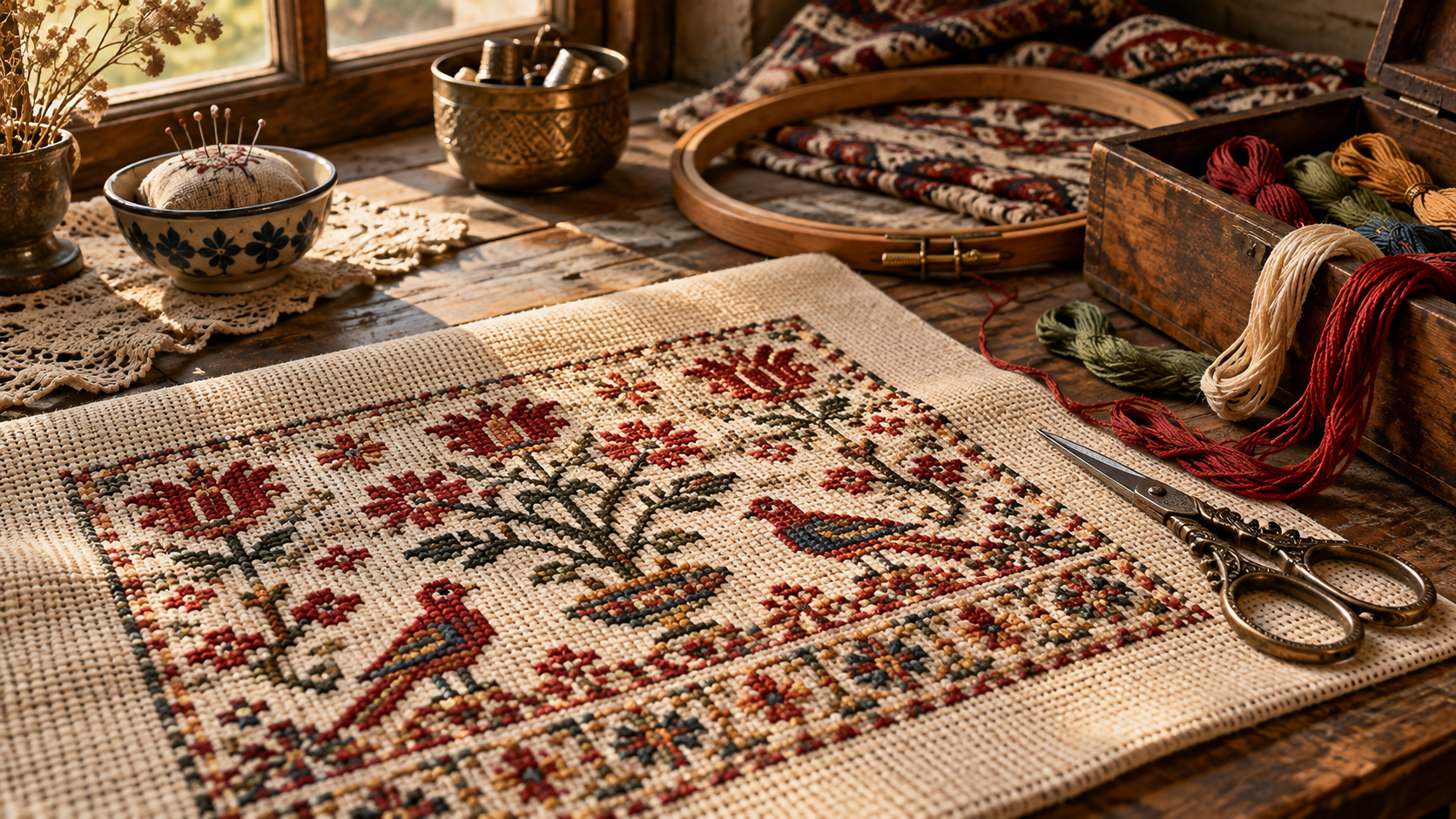
Etamin is an evenly woven fabric whose threads can be counted to place a pattern. Cross-stitch is an embroidery technique that makes X-shaped stitches across a fabric. Etamin is a common ground for cross-stitch, but the two terms are not synonyms. A description such as “cross-stitch on etamin fabric” identifies both the material and the technique.
The density of the weave, thread thickness and motif all change the finished piece. A flower may look small and intricate on a finer ground, or bold and graphic on a wider weave. When examining an older piece, it helps to look at the ground fabric and the stitches as well as the design.
How can we trace the history of counted embroidery?
Embroidery did not begin at one documented place and spread along a single, simple route. Different places developed their own materials, motifs and ways of stitching. The Victoria and Albert Museum's collection shows that embroidered samplers served both as exercises and as references for later designs. According to the museum, by the nineteenth century English school samplers were worked predominantly in cross-stitch. The collection also includes a nineteenth-century sampler from Turkey. These surviving examples help document practice; they do not establish the date on which today's etamin fabric was invented.
Pattern books and, later, prepared embroidery supplies made designs easier to share. Yet a chart never determines the whole result. The maker chooses the colour, spacing, border and object that will carry the design. Those decisions are part of the work's history too.
Cross-stitch in Anatolian everyday life
In Anatolia, cross-stitch is found on objects made for use as well as display: covers, bedding, towels, wrapping cloths and prayer mats. Research on cross-stitch in Anatolian Turkish culture describes its place in trousseaux and bedding, drawing on examples from Afyon and Bursa. No single list of colours, motifs or uses can stand for every region.
A motif cannot automatically be assigned one fixed meaning either. One family may choose a flower for its appearance; another may connect it with a memory. A study of deer motifs in cross-stitch explores their symbolic role in particular trousseau contexts. When describing a new product, the maker's own account is more reliable than attributing “fertility” or “protection” to every example of a motif.
From the trousseau chest to new designs
Some embroidered pieces remain family keepsakes. Others belong firmly to the present: personalised nursery pictures, details on bags, modern home textiles and framed wall art. Research into cross-stitch in contemporary art also shows how makers and artists can reinterpret a traditional technique.
A maker might borrow a detail from an inherited cover, change its colours or invent a completely new motif. Carrying knowledge forward does not require making identical copies of old objects. The fabric can hold both memory and a fresh point of view.
How to look closely at an older piece
- Ground: Notice the weave, thread count and condition of the fabric.
- Technique: Check whether cross-stitch is combined with other stitches or edge finishes.
- Use: Was the piece made as a wall hanging, towel, cover, wrapping cloth or prayer mat?
- Story: Record the maker, place and family history when known. Label guesses as guesses.
- Care: Older fabrics and dyes may be fragile. Cleaning should reflect the condition and materials of the actual piece.
Frequently asked questions
Are etamin and cross-stitch the same thing? No. Etamin is a fabric; cross-stitch is a technique. In everyday Turkish, “etamin embroidery” may be used for a finished cross-stitched object.
Is cross-stitch only made for trousseaux? No. It has a documented place in trousseau traditions, but it is also used for pictures, accessories, personalised gifts and home textiles.
Do we know the exact date etamin embroidery began? No single date can responsibly be given. Examples of cross-stitch and counted embroidery survive from different times and places.
Every piece of etamin embroidery reflects choices about material, technique and time. When you discover a piece on Tospika, look at the maker's story as well as the motif.