How to Choose and Care for Handmade Crochet Products
Colour and pattern are only part of choosing a handmade crochet item. Fibre content, stitch structure, joins and care requirements directly affect how the piece feels, performs and ages.
Choosing well begins with asking the maker clear questions. Caring well means cleaning only when necessary, drying the item with full support and storing it without placing avoidable strain on the stitches.
What should you check before buying handmade crochet?
1. Ask about fibre content
“Craft yarn” is not a complete material description. Cotton, wool, linen, raffia, acrylic and blended yarns have different textures and care requirements.
Useful questions include:
- What is the exact fibre content?
- Can the item be washed?
- Is there a risk of colour transfer or shrinkage?
- Was it designed for a baby or for direct skin contact?
- Does it contain wire, beads, buttons, lining or stuffing?
For baby products, do not rely only on broad claims such as “natural” or “organic”. Ask for the fibre composition, construction details and intended age group.
2. Match the texture to the purpose
Not every crochet fabric performs in the same way. Bags and baskets may need dense stitches that resist stretching under weight. Shawls and garments may require drape and freedom of movement.
Stuffed amigurumi is normally worked tightly enough to prevent filling from showing through. Open spaces in a decorative wall hanging, by contrast, may be an intentional part of the design.
3. Examine joins and finishing
Motif joins, handles, buttons and yarn ends often receive the greatest stress. Ends should be secured, joins should remain balanced, and load-bearing parts should suit the expected use.
Handmade does not mean careless. Small variations in measurement may be natural; structural weakness is a separate issue.
4. Request measurements
Scale can be difficult to judge from photographs. Ask for measurements in centimetres before buying a bag, garment, toy or household textile. Garments may require chest width, total length and sleeve measurements. Bags may require width, height, base depth and handle length.
5. Ask for care instructions before ordering
Good care advice is based on both fibre and construction. A cotton coaster, a wool garment and a lined bag should not automatically be cleaned in the same way.
How should handmade crochet be washed?
Always follow the maker’s or yarn manufacturer’s care instructions first. If the fibre is unknown or the item combines several materials, use the gentlest practical method and test for colour transfer in an inconspicuous area.
As a general approach:
1. Remove detachable accessories before washing.
2. Use cool or lukewarm water and a mild detergent suited to the fibre.
3. Do not scrub, wring or twist the item.
4. Rinse gently in clean water.
5. Press the item between clean towels to remove excess moisture.
Sudden temperature changes, agitation and unsuitable detergent can shrink or felt wool. Woolmark advises lukewarm water of about 30°C and a gentle detergent for wool labelled as hand washable, but the product’s own care claim always takes priority.
Items with beads, wire, glued components, rigid bases or specialised stuffing may not be suitable for full immersion. Ask the maker for instructions specific to the piece.
How should crochet be dried?
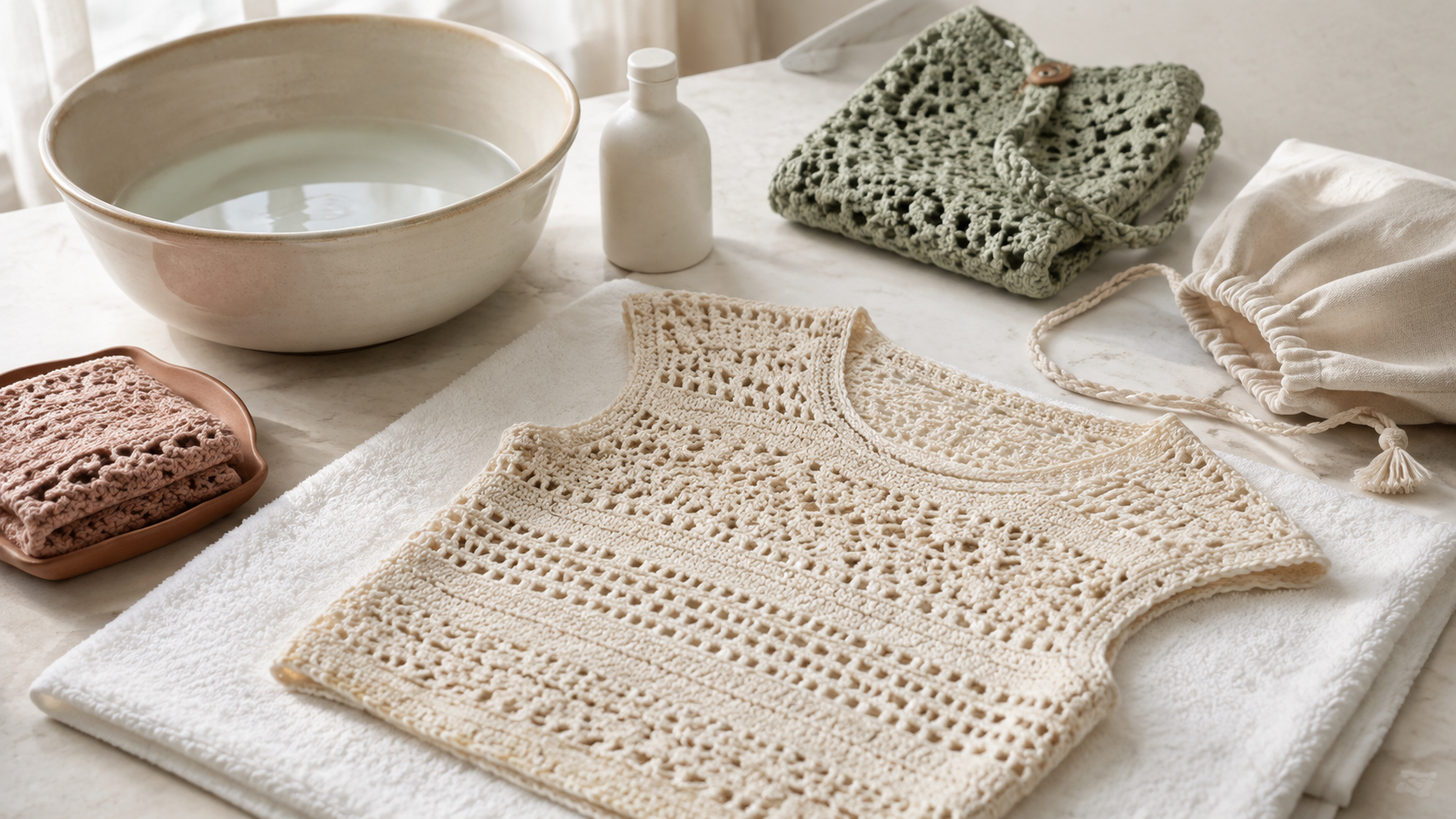
Crochet becomes heavier when wet and may stretch if hung. Garments, shawls and soft home textiles are generally safer when dried flat on a clean towel.
During drying:
- Keep the item away from direct sunlight and high heat.
- Avoid hanging if the weight may distort the shape.
- Gently return the item to its intended measurements while damp.
- Use a tumble dryer only when the care instructions expressly permit it.
Woolmark likewise recommends drying knitted wool items flat and in the shade whenever possible.
How should crochet products be stored?
An item should be fully clean and dry before long-term storage. Trapped moisture can contribute to odour, mould and fibre damage.
Rather than leaving garments and shawls on hangers, store them flat when possible so that their own weight does not stretch the fabric. Change fold lines occasionally for delicate pieces, avoid tight compression and protect textiles from prolonged direct light and dust.
The Canadian Conservation Institute recommends flat storage for many textiles because it supports the whole surface. Where folding is unavoidable, gently supporting the folds can reduce long-term creasing and distortion.
Why is direct communication with the maker useful?
The person who made an item can explain its materials, dimensions, production time and care needs. Direct discussion also helps clarify colour changes, custom sizing and intended use before an order is agreed.
Tospika is a discovery platform that makes the work of women makers visible; it is not a party to the sale. Product specifications, price, payment, shipping, delivery and personalisation are agreed directly between the buyer and the maker.
To compare different fibres, structures and uses, explore handmade crochet products.
Frequently Asked Questions
Can crochet be washed in a washing machine?
Only when the maker’s or yarn manufacturer’s care instructions permit it. If you are unsure, gentle hand washing is a safer starting point, while pieces with accessories may require specialist care.
Why should crochet be dried flat?
The weight of water can pull on the loops, causing stretching and distortion. Flat drying supports the entire item.
How should a crochet bag be cleaned?
Consider the yarn, lining, base, handles and decorative components together. A bag with a rigid base, wire or glued sections may need careful spot cleaning rather than immersion.
Are measurement differences normal in handmade products?
Small variations of a few millimetres are natural in hand production. For fitted garments or structured bags, request precise measurements in centimetres before ordering.
Related reading: Crochet: A 200-Year Tradition Reimagined by Today’s Makers