Etamin Prayer Mats: Use and Place in Turkish Culture
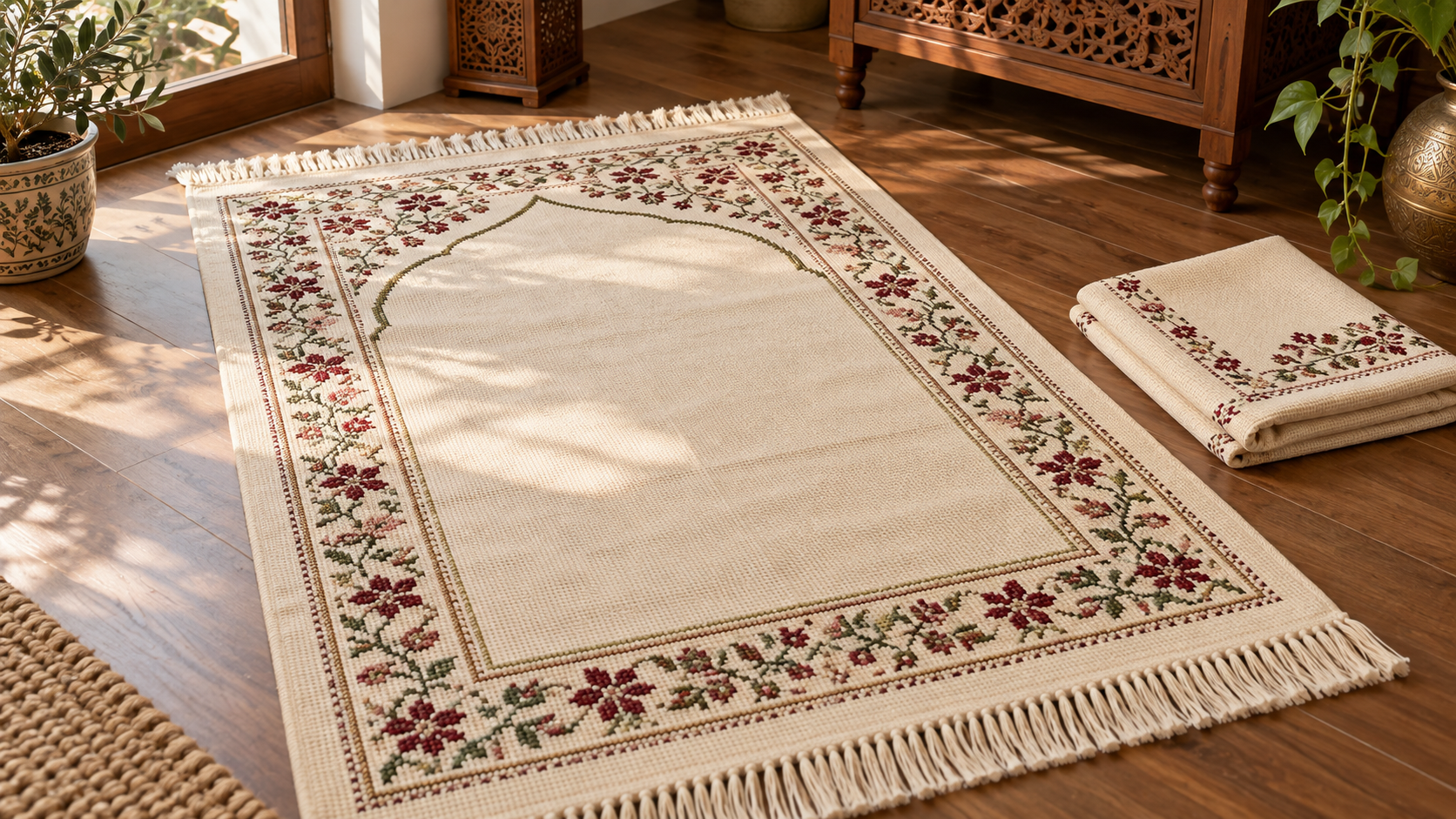
A prayer mat provides a clean space set aside for worship. Hand embroidery can add time, memory and, in some families, a story passed between generations. To understand an etamin prayer mat, it helps to consider both its practical purpose and the fabric, design and workmanship chosen by its maker.
What is an etamin prayer mat?
An etamin prayer mat uses evenly woven etamin fabric across all or part of the mat and is often decorated with counted embroidery such as cross-stitch. Not every embroidered prayer mat is made of etamin: makers also use other fabrics, weaving methods and embroidery techniques. A useful product description names the ground fabric and the decoration separately.
Prayer mats differ in size and construction. For a piece intended for worship, adequate space, ease of keeping it clean, stability on the floor and suitable dimensions are practical considerations. Decoration should not make the mat uncomfortable to use.
The prayer mat in Turkish culture
Known in Turkish as seccade, namazlık or namazlağ, prayer mats appear in different textile traditions. Research on woven prayer mats from the Antalya region treats them as textiles with a religious use and documents local examples. That study is about woven mats; it does not suggest that all prayer mats are made of etamin.
A more specific study of cross-stitched prayer mats examines ten trousseau pieces from the Gemerek district of Sivas. Researchers recorded their fabrics, colours, patterns and compositions. This small regional group shows that embroidered prayer mats were kept as trousseau items in some families. It cannot stand for the customs of everyone in Turkey.
In trousseaux and family memories
Some families make or give an embroidered prayer mat as part of marriage preparations. It may be presented with a wrapping cloth or kept as an individual gift. The time devoted to its making can give it a value beyond daily use. Still, the way a mat is prepared and used differs between families, places and individuals.
The same care applies to motifs. A flower may be chosen simply because the maker likes it. If a motif has a particular meaning for its maker, letting that person tell the story gives the product description more depth than assigning a universal meaning to the pattern.
What to check when choosing a prayer mat for regular use
- Ask for dimensions. Check length and width against the user's needs.
- Examine the underside. Ask whether the mat moves on the floor and whether it has a backing.
- Look at the placement of the embroidery. Raised stitches, beads or other decorations may affect comfort.
- Identify the materials. The ground fabric, embroidery thread, lining and any fringe should be described.
- Confirm care instructions. Washing and drying depend on the actual fabric, thread, dye and finish.
- Request clear photos. The full mat, stitch detail, back and edge finish should be visible.
There is no single perfect construction for everyone. The useful question is whether the particular piece suits the person who will use and care for it.
How should an embroidered prayer mat be kept?
Let the mat dry completely after use before storing it in a clean, dry place. Avoid leaving a folded piece under heavy objects for long periods. There is no universal washing temperature or detergent suitable for every handmade mat. Follow the maker's instructions; a fragile inherited textile may call for advice from a textile conservator. Reducing friction that can catch threads and avoiding prolonged direct sunlight may help protect its appearance.
Frequently asked questions
Can an etamin prayer mat be used every day? A mat made for regular use can be, provided its comfort, grip, dimensions and care requirements suit the user.
Is every etamin prayer mat a trousseau item? No. It can also be made for everyday use or as a personal gift. “Trousseau” describes its purpose or context, not a separate textile technique.
Can it be machine washed? There is no answer that applies to every mat. Fabric, thread, lining, dye and embellishments differ. Follow the maker's product-specific instructions.
When considering an etamin prayer mat, look first at its suitability for use, then at the details of the workmanship and its real story. On Tospika, you can discuss a piece's specifications and delivery directly with its maker.