
The Anatolian Dowry Tradition and the Symbolic Language of Dowry Chests
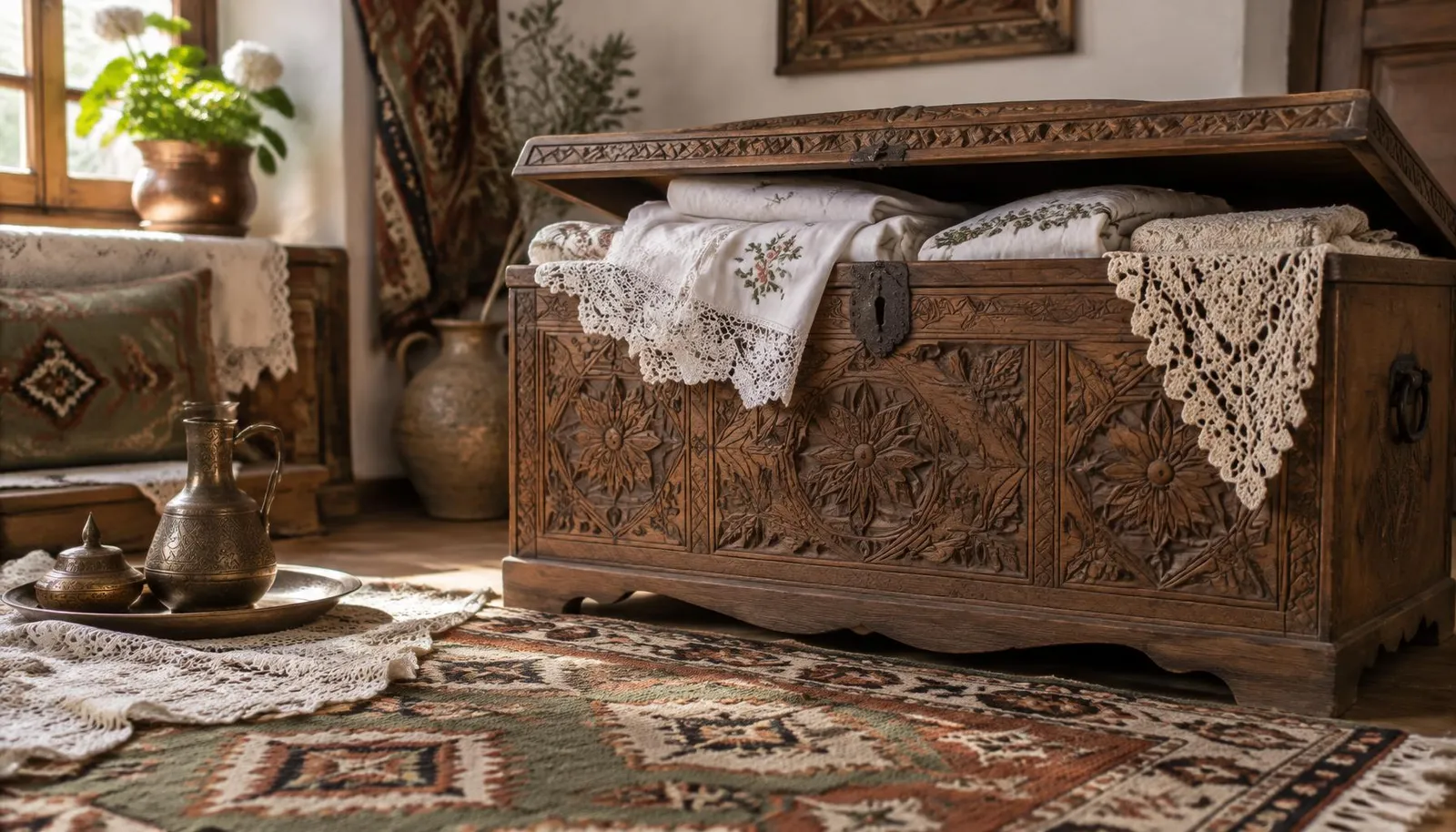
Does a chest hold only objects?
When a dowry chest was opened in Anatolia, it revealed far more than lace, embroidered cloths, woven textiles and household objects. With its lid came the memory of a family, generations of women’s work, hopes for the future and a culture carefully carried forward.
Today, the word “dowry” is often associated with objects prepared before marriage. In Anatolia, however, the tradition had a much broader meaning. It helped prepare a new household, but it also made craftsmanship, sharing, family ties and local aesthetics visible.
A tradition prepared over many years
In many parts of Anatolia, dowry preparation began long before a young woman reached marriage age. A well-known Turkish saying, roughly meaning “the girl is in the cradle while the dowry is already in the chest,” reflects the long duration of this preparation. The contents varied according to regional customs and the economic means of each family.
Woven fabrics, bedding, quilts, covers, towels, bundles, lacework, embroidery, carpets, kilims, cushions and many practical household pieces could become part of a dowry. Yet their value was not limited to usefulness. Who made them, which technique was used, which motifs were chosen and how much time the work required all became part of their story.
The dowry chest: from storage furniture to family archive
The chest is one of the most recognizable symbols of the dowry tradition. Turkish communities had long used portable bundles, bags and containers for storing and transporting belongings, while wooden chests gradually became an important part of settled domestic life.
A dowry chest protected objects considered private, valuable or special. Textiles were carefully folded, wrapped and separated. In this way, the chest functioned almost like a small domestic archive, safeguarding both useful objects and family memories.
Some chests passed from mother to daughter and from grandmother to granddaughter. Their contents changed, but the chest itself remained. An old dowry chest can therefore be understood not simply as furniture, but as an object carrying traces of several generations.
Why were the motifs on dowry objects important?
In Anatolian crafts, a motif is often more than decoration. Motifs can become visual signs through which people express ideas about nature, family, marriage, fertility, protection and the cycle of life.
The tree of life, birds, water, flowers, stars, ram’s horns, the “eli belinde” female figure and numerous geometric forms appear on chests and dowry textiles. Their meanings differ across regions and periods, so no motif should be treated as having one rigid meaning throughout Anatolia. Nevertheless, several recurring symbolic associations can be observed.
Tree of life
The tree of life is associated with continuity, roots, family, abundance and the connection between generations. On a dowry object, it can evoke the wish that a newly established household will grow and endure.
Bird
Bird motifs may suggest freedom, news, longing, spirit and travel. In the context of marriage and a move from one household to another, their associations with departure and new beginnings become especially resonant.
Water and flowers
Water has long been linked with life, purity and abundance, while flowers suggest renewal, beauty and vitality. The prominence of plant motifs in embroidery also shows how closely domestic aesthetics were connected with the natural world.
Ram’s horn
The ram’s horn is commonly associated with strength, vitality and power in the repertoire of Anatolian motifs. It appears in kilims and various forms of weaving and may also be combined with themes of family and abundance.
Eli belinde
The motif known as “eli belinde,” a stylized female form, is one of Anatolia’s best-known textile motifs. It is associated with womanhood, motherhood, fertility and continuity of life, creating a particularly strong connection with the female labour embodied in dowry preparation.
Could a motif become a silent letter?
In traditional communities, emotions and wishes were not always expressed directly. Motifs used in weaving and embroidery created another visual language. Research on Turkish motifs shows that expectations around family and marriage, as well as joy, disappointment and longing, could be conveyed through textile design.
A shape woven into a kilim or a detail on the edge of an embroidered bundle therefore need not be read merely as decoration. Sometimes it may preserve the trace of a thought that its maker never expressed in words.
The dowry as a network of knowledge among women
A dowry was rarely the work of one person alone. Mothers, grandmothers, aunts, neighbours and other women within a community could take part in its preparation, sharing techniques, patterns and practical knowledge.
Learning lace, embroidery, weaving or crochet was not simply a way of producing an object. It was also a way of entering the visual memory of a community. Dowry preparation thus became an informal but powerful system of learning and cultural transmission.
There was never just one Anatolian dowry tradition
Anatolia is far too diverse for us to speak of a single uniform dowry culture. Materials, colours, textile techniques and the objects given priority varied from the Aegean to Central Anatolia, from the Black Sea region to eastern and southeastern Anatolia.
One region might emphasize kilims and woven textiles, while another became known for embroidery, needle lace, cross-stitch, crochet or other techniques. These differences turned dowry practices into expressions of local identity.
Displaying the dowry: when hidden labour became visible
One of the most striking stages of the tradition was the public display of dowry pieces. Objects prepared over many years could be shown to relatives and the surrounding community, making women’s labour visible in a ritualized form.
This practice could also create social pressure because it sometimes reflected a family’s economic status and conformity with community expectations. For this reason, the dowry tradition should not be romanticized as a purely nostalgic custom. It included solidarity and creativity, but also social expectations and gender roles.
What remains of the tradition today?
Mass-produced textiles, smaller homes, changing lifestyles and modern patterns of consumption have transformed the traditional dowry. Many people now purchase household goods when they need them rather than preparing a chest over many years.
Yet the cultural memory of the dowry has not disappeared. A piece of lace inherited from a grandmother, a cross-stitched cloth, handmade slippers or an old wooden chest can still connect the present to family history.
At the same time, renewed interest in handmade work is giving traditional techniques new lives. Historic motifs appear in contemporary design, older crafts are being learned again, and makers are finding new audiences through digital platforms.
The chest closes, but the story remains
Perhaps this is the most compelling part of the Anatolian dowry tradition: its ability to give memory to everyday things. A towel is no longer only a towel, a kilim no longer only a floor covering, and a chest no longer merely furniture once the stories of those who made, preserved and passed them on become part of the object.
We do not need to reproduce the past exactly in order to value it. Recognizing the labour, imagination and knowledge preserved inside the dowry tradition offers a powerful way to understand Anatolia’s handmade heritage.
When we discover traditional crafts and contemporary makers on Tospika, we are also witnessing new pages in this long story. Handmade culture changes its form, but the human stories that give it meaning continue.
Sources
- Anadolu Kadınıyla Özdeşleşen Kültür Taşıyıcısı Çeyiz Sandıklarının Dili ve Çağdaş Sanat Uygulamalarında İzdüşümleri Üzerine Bir Araştırma — Gümüşhane Üniversitesi Sosyal Bilimler Dergisi, 2025
- Türklerde Çeyiz Sandığının Kullanımı ve Geleneksel Süslemeleri — Ordu Üniversitesi Sosyal Bilimler Araştırmaları Dergisi, 2010
- Halk Kültüründe Resimli Sandıklar — Milli Folklor, 2024
- Motiflerin Diliyle Aile ve Evlenme Kavramı — Ahi Evran Üniversitesi Sosyal Bilimler Enstitüsü Dergisi, 2026
- Mucur Yöresi Çeyiz Geleneğinde Yer Alan Dokumalar — Hars Akademi, 2022