Tax Exemption for Women Producing at Home: Can You Sell Without Setting Up a Company?
Many women who create handmade products ask the same question before they begin selling:
“Do I need to set up a company to sell the products I make at home?”
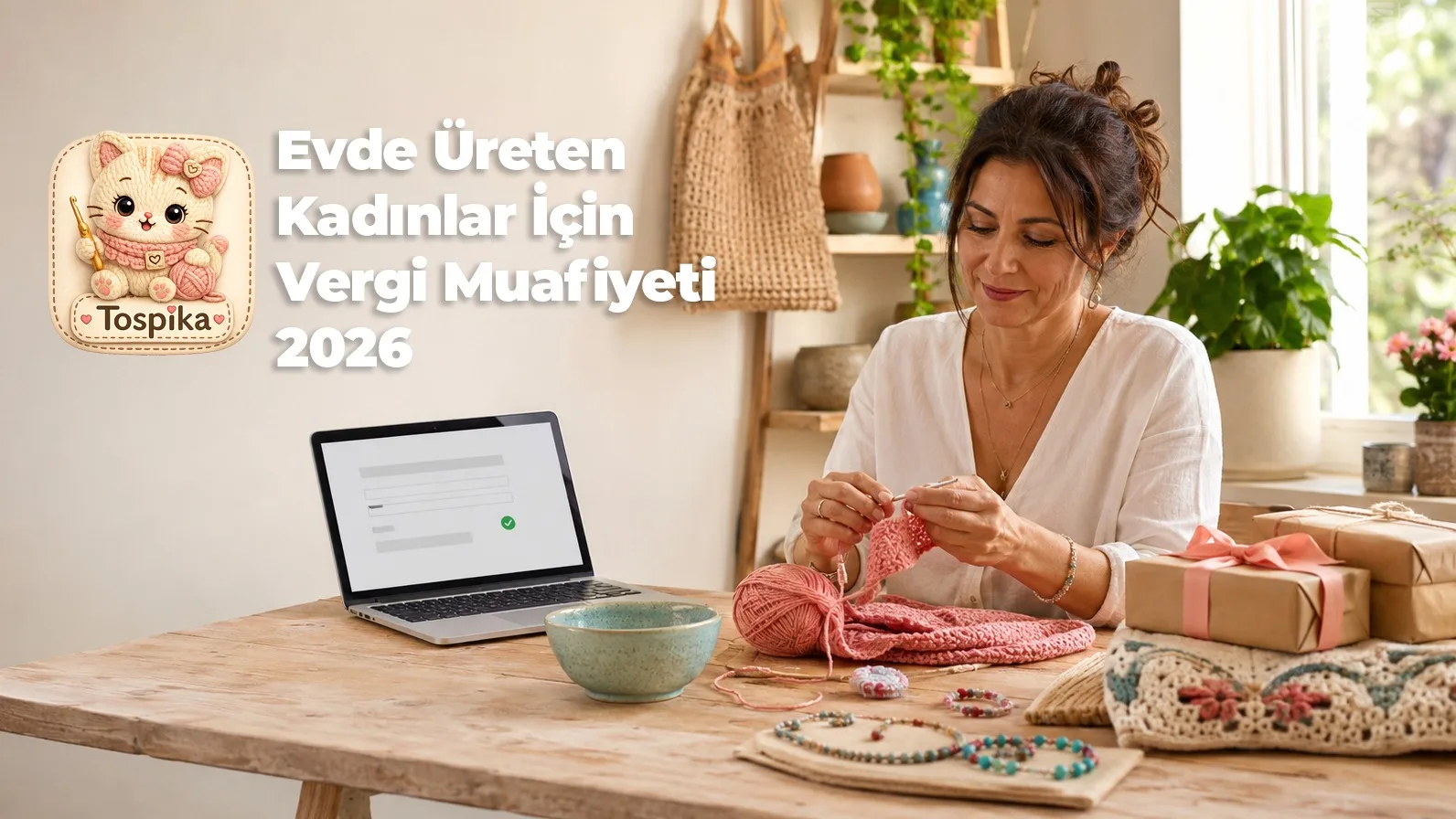
In Türkiye, people who create products at home through their own labour may sell them without setting up a company or registering as income taxpayers, provided they meet certain conditions. This opportunity is offered under the “tradesperson exemption” provisions of the Income Tax Law.
However, the tradesperson exemption does not mean that all sales are tax-exempt without conditions. How the product is made, where it is sold, how the sales income is collected and the total annual sales amount all matter.
In this article, we explain clearly and simply the conditions under which home-based producers may benefit from the tradesperson tax exemption.
What is the tradesperson tax exemption?
The tradesperson tax exemption allows people who produce on a small scale through their own labour to operate without registering as income taxpayers, within the framework of specified conditions.
Producers who meet the conditions generally do not need to:
Set up a company,
Register as an income taxpayer,
Keep accounting records,
File an income tax return,
Issue an invoice for every sale.
However, depending on the sales method, the bank may deduct tax from sales income. Producers must also keep documents relating to purchased materials and production expenses.
Who can benefit from the tradesperson exemption?
The tradesperson exemption is not exclusively for women. Anyone who meets the conditions set out by law may benefit from it. However, because it offers valuable support to women producing from home, it is especially common among women makers.
The main conditions for benefiting from the exemption include:
Preparing the products in the producer’s home,
Basing production on the producer’s own labour,
Not opening a separate workplace,
Not using industrial machinery or equipment capable of mass production,
Not allowing the activity to develop into large-scale commercial production,
Not being subject to income tax under the standard assessment regime due to commercial, agricultural or professional earnings.
Not every product or production method automatically falls within the exemption. Producers should therefore ask their tax office about their specific product and sales method.
Which handmade products may be covered?
Examples of products that may be prepared at home and considered within the scope of the tradesperson exemption include:
Knitted and crocheted products,
Lace and embroidery,
Towels, covers, sheets and similar textile products,
Beaded products,
Wickerwork and baskets,
Artificial flowers,
Gifts and tourist souvenirs,
Handmade decorative products,
Certain homemade foods such as tarhana, noodles and mantı.
This list does not guarantee eligibility for every product or production method. Food, cosmetics, soap, candles and similar products may also be subject to regulations issued by the Ministry of Agriculture and Forestry, Ministry of Health, municipalities or other authorities responsible for product safety, in addition to tax legislation.
Obtaining a Tax Exemption Certificate does not mean that other permits and obligations relating to the product have automatically been fulfilled.
Two different exemptions depending on the sales method
The tradesperson exemption available to home-based producers may vary depending on how their products are sold.
Those who also sell outside the internet
People who sell certain products made at home through their own labour without opening a workplace may benefit from the tradesperson exemption if they meet the conditions under Article 9, paragraph 1, subparagraph 6 of the Income Tax Law.
Under this method, products may also be sold online and, subject to the relevant conditions, at temporary sales areas designated by public authorities, certain charity fairs, festivals or fairs.
However, particular attention must be paid to conditions such as:
Not employing outside workers,
Not engaging in mass production,
Not opening a separate workplace,
Not making continuous sales by regularly following markets,
Not exceeding the relevant annual limit for online sales.
Those who sell their products only online
A different exemption model is available to those who sell exclusively through Instagram, WhatsApp, websites, social media or other online platforms.
Those wishing to benefit from this model under Article 9, paragraph 1, subparagraph 10 of the Income Tax Law must:
Apply to the authorised tax office where they reside,
Obtain a “Tradesperson Tax Exemption Certificate”,
Open a business account for sales at a bank in Türkiye,
Collect all income from online sales through this account,
Sell products only online or through similar electronic channels,
Not use industrial machinery capable of mass production,
Not open a separate workplace,
Not exceed the annual revenue limit.
For 2026, the annual revenue limit under this provision is TRY 1,900,000. If more than one product is sold, the limit is assessed on the total sales income from all products, rather than separately for each product.
Does “tax-exempt” mean that no tax is paid?
No. Describing this arrangement as “completely tax-free sales” may be misleading.
For producers who sell only online and benefit from the exemption under Article 9/1-10, banks generally deduct income tax at a rate of 4% from sales amounts paid into their designated business accounts.
If workers are employed under the conditions specified by law, this rate may be reduced to 2%.
Because the bank makes the tax deduction, producers do not need to file a separate income tax return for this income. However, the account must be used only to collect payments from sales covered by the exemption, and all sales income must be deposited into it.
The clearest way to describe this system is:
“You may sell without setting up a company, keeping accounting records or filing an income tax return; however, depending on the sales method, the bank may apply withholding tax.”
How do you obtain a Tradesperson Tax Exemption Certificate?
You can apply for a Tradesperson Tax Exemption Certificate at the authorised tax office where you reside.
You can also apply electronically through the Digital Tax Office:
Digital Tax Office → My Petitions → Create New Petition → Tradesperson Tax Exemption Petition
After assessing the application and production activity, the tax office approves the certificate if the conditions are met.
The Tradesperson Tax Exemption Certificate must be renewed every three years. Producers must also retain records of materials, expense vouchers and other documents relating to their activities for five years.
What happens if the annual sales limit is exceeded?
If the annual revenue of a producer selling only online under Article 9/1-10 exceeds the TRY 1,900,000 limit set for 2026, they may continue to benefit from the exemption for the current year.
However, from the beginning of the following calendar year, the producer can no longer benefit from this exemption, and income tax registration may become necessary.
Failure to deposit all sales income into the specified bank account, opening a workplace, engaging in mass production or no longer meeting any of the exemption conditions may also result in tax penalties.
It is therefore important to monitor sales and bank transactions regularly.
What should producers showcasing their products on Tospika consider?
Tospika is a free digital showcase platform where women makers can present their profiles and products in Turkish, English and German.
Sales, payments and money collection do not take place directly through Tospika. Visitors who like a product contact the producer directly through Instagram, WhatsApp or other communication channels.
Therefore, responsibility for the following rests with the producer:
The sale of the product,
Receiving payment,
Shipping arrangements,
Tax and documentation obligations,
Legal permits relating to the product.
Displaying products on Tospika does not, by itself, replace a Tradesperson Tax Exemption Certificate. However, when a buyer discovers a product on Tospika and contacts the producer through Instagram or WhatsApp, the resulting sale should be considered part of the producer’s own sales channel.
Why is it important to seek information before starting production?
Every producer works with different products and materials, sells through different channels and earns a different annual income. An exemption method suitable for one producer may not be suitable for another.
Before beginning sales or applying for a Tradesperson Tax Exemption Certificate, it is therefore advisable to obtain current, personalised information from:
Your local tax office,
A financial adviser,
The relevant public authority for your product type.
Acting on accurate information helps women makers grow their work with confidence and avoid potential tax issues in the future.
Let your handmade work be seen
If you create products at home and would like to reach more people, you can create a free producer profile on Tospika.
Share your products in three languages and let visitors from Türkiye and around the world discover your work. Interested visitors can contact you directly, without an intermediary.
Take your place on Tospika and let your handmade work cross borders.
Note: This article has been prepared for general information purposes and does not constitute financial or legal advice. As legislation and annual monetary limits may change, it is advisable to review the latest guidance from the Revenue Administration before applying.
Source: Revenue Administration — Tradesperson Exemption under Article 9 of the Income Tax Law