
How Can Antep-Inspired Hand-Painted Fabrics Be Used?
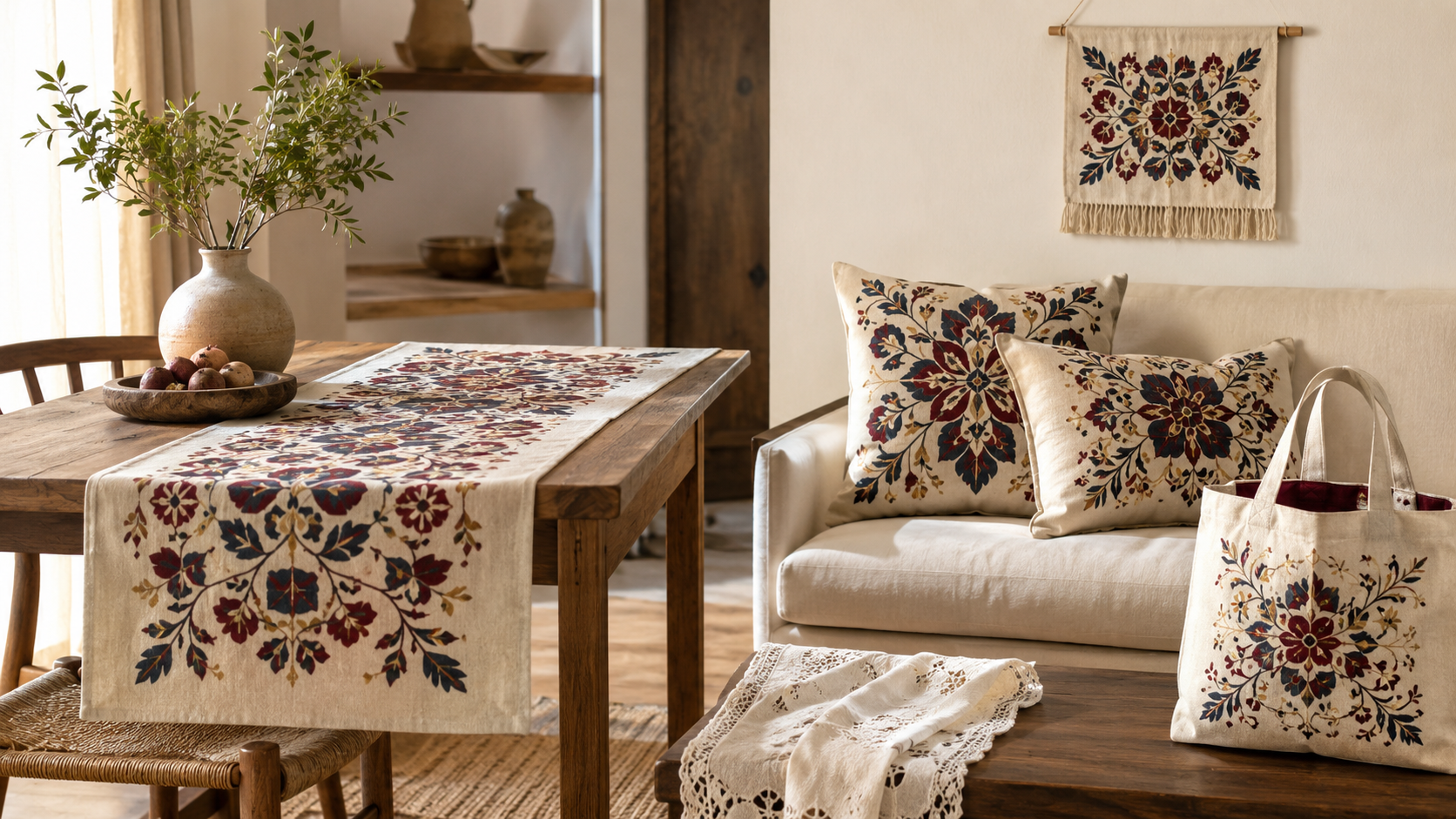
Hand-painted fabric can transform an everyday object into a distinctive piece carrying the maker’s touch. Geometric borders, plant forms and balanced repetitions inspired by Antep embroidery can be adapted to home textiles and accessories. The key is to describe a painted piece accurately rather than confusing it with traditional drawn-thread embroidery.
At the table: runners, cloths and napkins
Repeating borders naturally suit table runners. In a simple setting, one painted runner can become the focal point. Smaller corner motifs work well on napkins and placemats.
Before buying, ask whether textile-specific paint was used, how the colour was fixed and how stains should be treated. Care information is particularly important for items that will be washed frequently.
In living spaces: cushions and textile wall art
Decorative cushions offer an easy way to introduce heritage-inspired patterns into a modern interior. Burgundy, indigo and earth tones on cream linen can create a warm, timeless effect. Wall textiles allow more detailed compositions and let the texture of the cloth become part of the artwork.
Prolonged direct sunlight may fade some pigments. Ask the maker for display recommendations when choosing a location.
In daily life: tote bags and small accessories
Tote bags, pouches, glasses cases and fabric-covered notebooks bring textile painting into daily use. Unlike mass printing, hand painting naturally produces small variations in colour density and brushwork. Even two pieces based on the same pattern may not be completely identical.
For frequently used bags, consider fabric weight, seam strength and the resistance of the painted surface to rubbing.
For special occasions: meaningful gifts
Hand-painted textiles can make thoughtful housewarming, wedding, anniversary or new-job gifts. If you would like personalised colours, motifs or initials, ask about the maker’s production time in advance. Handmade work follows a different timetable from ready-made industrial products.
How should hand-painted fabric be cared for?
Care depends on both fabric and paint, so the maker’s instructions should always come first. As a general guide:
- Turn the item inside out and wash at low temperature on a gentle cycle.
- Avoid bleach and aggressive stain removers.
- Do not leave the painted surface soaking for long periods.
- Prefer air drying to tumble drying.
- If ironing is permitted, iron from the reverse or through a protective cloth.
These are general precautions rather than a replacement for product-specific guidance.
Recognising genuine handmade value
A clear product description should state the fabric, paint, application method and fixing process. The phrase “Antep-inspired hand-painted textile” acknowledges the cultural source while making clear that the piece is not traditional drawn-thread Antep embroidery.
On Tospika, you can contact women makers directly to ask about dimensions, colours, care and personalisation, and choose a textile whose labour and story remain visible.